Outer hip pain that flares when you walk, climb stairs, or lie on your side at night is one of the most misunderstood and undertreated musculoskeletal conditions around — but the research is now clear on what actually works. If you’re in Victoria BC and your hip has been bothering you for more than a few weeks, this is worth reading.
Victoria is a city built for active living. The Galloping Goose, Mount Doug, Elk Lake, the Dallas Road waterfront — locals here walk, hike, cycle, and run year-round. Which makes persistent hip pain especially frustrating. Not just because it hurts, but because it quietly limits the outdoor life this city is built for.
If you’ve been dealing with aching, stiffness, or a sharp catch on the outer side of your hip — especially after sitting for long stretches, climbing stairs, or trying to sleep on your side — you may be dealing with gluteal tendinopathy. It’s one of the most common causes of lateral hip pain in active adults, and for years it was misunderstood, undertreated, or treated in ways that actually made it worse.
The good news: we now know what causes it, what makes it worse, and — crucially — what fixes it.
What Is Gluteal Tendinopathy?
Gluteal tendinopathy is an overload-related condition affecting the tendons that attach the gluteal muscles (primarily gluteus medius and gluteus minimus) to the greater trochanter — the bony prominence you can feel on the outer side of your hip.
It’s part of a broader condition often referred to as Greater Trochanteric Pain Syndrome (GTPS).
Gluteal tendinopathy is particularly common in:
– Women over 40 (hormonal changes affect tendon tissue quality)
– Runners and cyclists who’ve recently increased training load
– People who sit for long periods with legs crossed or in hip adduction
– Anyone who’s recently taken on more hiking, stair climbing, or walking on varied terrain
Research Stat: A 2024 systematic review with meta-analysis in Scientific Reports examined exercise-based interventions for gluteal tendinopathy. Exercise therapy demonstrated significantly better outcomes than corticosteroid injections and minimal intervention at 8 and 52 weeks for both pain intensity and function, with evidence rated as moderate-to-strong.
Why Rest Makes It Worse (And What to Do Instead)
Complete rest is one of the worst things you can do for gluteal tendinopathy.
Tendons require mechanical load to maintain and rebuild their structure. Without load, tendon tissue actually becomes less organized, weaker, and more reactive to normal stresses of daily movement.
The goal of treatment is not rest — it’s load management: finding the right amount and type of mechanical stimulus to drive tendon adaptation, while avoiding positions and movements that provoke compressive loading on the tendon.
Positions to avoid during early recovery:
– Crossing your legs when sitting — creates compressive load on the gluteal tendons
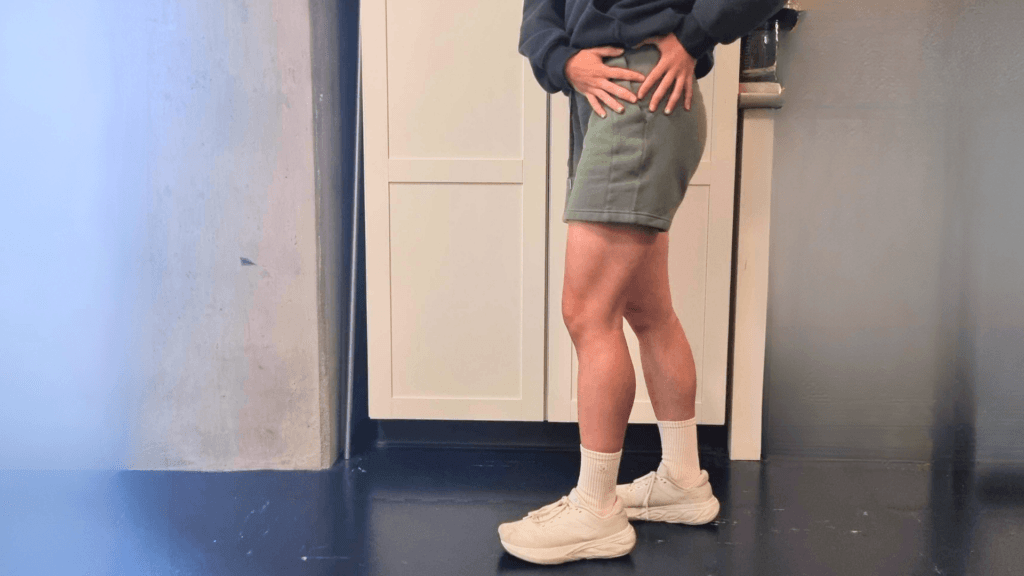
– Standing with your weight shifted onto one hip
– Sleeping on your side without a pillow between your knees
– Deep hip stretches targeting the piriformis or IT band — these directly compress the tendons that need to heal
Active vs. Passive Therapy: What the Research Actually Supports
The evidence for passive treatments as primary interventions for gluteal tendinopathy is weak. What the research strongly supports is a specific type of progressive exercise program targeting the gluteal muscles — combined with education about load management.
At Pursuit Physiotherapy in Victoria, we don’t use ultrasound, IFC, TENS, or passive electrotherapy. These modalities don’t address the underlying tendon pathology.
The best treatment for gluteal tendinopathy isn’t something done to you — it’s a carefully designed loading program done by you, with expert guidance on how to progress without provoking the tendon. That’s what one-on-one physiotherapy makes possible.
The Physio + RMT Integration for Hip Pain
Your physiotherapist leads the assessment, diagnoses the tendinopathy, and prescribes the progressive loading program.
Your RMT addresses the surrounding muscle tension — the TFL, piriformis, hip flexors, and lumbar paraspinals. By reducing guarding and improving tissue quality in the gluteal muscles, RMT creates a better environment for your progressive loading work to succeed.
Think of it as the difference between trying to remodel a room with the furniture piled up in the middle versus starting with a cleared space. The exercise is the remodel; the massage therapy clears the floor.
For hip pain, the combination of progressive tendon loading (physio) and soft tissue preparation (RMT) consistently produces better outcomes than either approach alone. At Pursuit, your physio and RMT team communicate so your care plan is coordinated, not coincidental.
The Pursuit Approach to Hip Pain Recovery
Phase 1 — Calm the Tendon (Weeks 1–3): Strategic load reduction, isometric exercises.
Phase 2 — Build Tendon Capacity (Weeks 3–10): Progressive isotonic loading — slow, heavy resistance work to drive tendon remodelling.
Phase 3 — Functional Loading (Weeks 8–16): Dynamic and sport/activity-specific exercises.
Phase 4 — Return to Full Activity: Criteria-based, not calendar-based.
Realistic Expectations
Gluteal tendinopathy typically takes 8–12 weeks of consistent rehabilitation for meaningful improvement, and up to 6 months for full return to high-demand activity. Many patients report that by the end of recovery, the affected hip is stronger than it was before.
Is It Gluteal Tendinopathy or Something Else?
Conditions commonly confused with gluteal tendinopathy:
– Hip bursitis (trochanteric bursitis) — often co-exists
– IT band syndrome — lateral thigh pain worse with running
– Referred pain from the lumbar spine — L4/L5 nerve root irritation
– Hip joint pathology (osteoarthritis) — typically presents with groin pain
– Piriformis syndrome — deep buttock pain
A thorough physiotherapy assessment will identify the primary driver.
Book a Post-Concussion Assessment in Victoria
If persistent hip pain is limiting your daily activities or preventing you from enjoying an active lifestyle, early treatment can make a significant difference. At Pursuit, our team provides personalized hip pain physiotherapy in Victoria BC to identify the cause of your symptoms, reduce pain, and help you return to the activities you enjoy with confidence.
Pursuit Physiotherapy
102B–740 Hillside Ave, Victoria, BC
Free 60-minute parking directly outside. Transit accessible (Hillside Ave at Blanshard and Douglas St. bus stops).
Direct billing available for WSBC, ICBC and all major extended health insurers. No physician referral required.
References
-
Systematic review and meta-analysis: Effects of exercise-based interventions on gluteal tendinopathy. Scientific Reports, 2024. DOI: 10.1038/s41598-024-53283-x. PMC: 10858207.
-
Bremer T, Nicklen P, Fearon A, Morrissey D. The efficacy of gluteal tendinopathy treatments: A systematic review. Clinical Rehabilitation, 2025. DOI: 10.1177/02692155251327298.
-
Physiotherapy management of gluteal tendinopathy. Journal of Physiotherapy (ScienceDirect), 2025. DOI: 10.1016/j.jphys.2025.01.001.
-
Grimaldi A, Fearon A. Gluteal tendinopathy: Integrating pathomechanics and clinical features in its management. Journal of Orthopaedic & Sports Physical Therapy, 2015;45(11):910-922. DOI: 10.2519/jospt.2015.5829. (Foundational — older than 5 years but seminal; flagged.)