
Persistent headaches, dizziness, brain fog, or neck pain that hasn’t cleared weeks after a head injury? This is post-concussion syndrome — and the evidence on how to treat it has changed dramatically.
When “You Just Need to Rest” Isn’t Working
You hit your head. Maybe it was a car accident on the Pat Bay Highway. Maybe it was a fall on the mountain bike trails in Thetis Lake Park. Maybe it happened playing soccer, or you slipped on the ice, or you simply took an awkward knock.
You were told — maybe by the ER, maybe by your GP, maybe by well-meaning friends — to rest in a dark room until the symptoms passed.
So you did. For days. Maybe weeks. But the headaches are still there. The dizziness lingers. You can’t concentrate at work the way you used to. Light and noise bother you in a way they never did before. Your neck is stiff and sore. And you’re starting to wonder if this is just your life now.
It doesn’t have to be. Post-concussion syndrome is a real, recognized clinical condition — and physiotherapy, specifically targeting the vestibular and cervical systems, is one of the most evidence-supported interventions available. But you need to know what to look for and where to start.
Victoria, BC has excellent concussion rehabilitation available. Here’s what you need to know.
What Is Post-Concussion Syndrome?
A concussion is a mild traumatic brain injury caused by a biomechanical force — direct or indirect — that disrupts normal brain function. Most concussions resolve within 7–14 days. But for roughly 15–30% of people, symptoms persist beyond that window — and this persistence is called post-concussion syndrome (PCS).
PCS is defined as the presence of concussion-related symptoms that last longer than the expected recovery period, typically 4 weeks or more from the initial injury. The symptom profile varies widely, but commonly includes:
- Headaches (often cervicogenic — originating in the neck)
- Dizziness or balance problems
- Sensitivity to light (photophobia) and sound (phonophobia)
- Cognitive difficulties — “brain fog,” difficulty concentrating, word-finding problems
- Fatigue, sleep disruption
- Emotional changes — irritability, anxiety, low mood
- Visual disturbances — blurred vision, difficulty tracking
The important thing to understand: these symptoms don’t all come from the brain itself. In PCS, the cervical spine, vestibular system, and visual-motor system are almost always involved — and these are precisely the systems that physiotherapy is designed to address.
RESEARCH STAT: A 2024 systematic review published in the Journal of Neurotrauma by Moser et al. found that non-pharmacological physical therapies — particularly those targeting the vestibular and cervical systems — produced statistically significant improvements in physical symptoms for patients with persistent concussion symptoms. DOI: 10.1089/neu.2023.0474
Why “Complete Rest” Is No Longer the Standard of Care
The “dark room, complete rest” approach to concussion management was dominant for years — and it caused real harm.
The evidence now shows that prolonged rest beyond the first 24–48 hours after acute concussion is associated with worse outcomes — not better ones. Extended physical and cognitive rest leads to physical deconditioning, increased anxiety about symptoms, and sensitisation of the nervous system to activity — a pattern that prolongs recovery rather than accelerating it.
Current clinical practice guidelines from the Concussion in Sport Group and the Canadian Guideline on Concussion in Sport (2023) recommend early, graduated return to activity — including guided physical activity and physiotherapy — as soon as symptoms are stable.
For PCS specifically, the evidence is even more clear: active rehabilitation targeting the specific systems involved in the patient’s symptom profile outperforms rest alone in every high-quality study conducted to date.
RESEARCH STAT: A systematic review on vestibular rehabilitation as an early intervention in athletes post-concussion found that earlier vestibular intervention had a direct relationship with earlier recovery and return to sport. Delaying vestibular rehabilitation more than 30 days post-injury was associated with prolonged recovery timelines. (International Journal of Sports Physical Therapy, 2023. PMC10324323)
The Three Systems Physiotherapy Targets in Post-Concussion Syndrome
Effective concussion physiotherapy is not generic. It’s guided by a thorough assessment of which systems are driving the patient’s specific symptom picture. The three primary targets are:
1. The Cervical Spine (Neck)
This is consistently underappreciated in concussion management. In most concussive events — particularly motor vehicle accidents — the head undergoes significant acceleration-deceleration forces. The cervical spine absorbs much of this force, and the result is often significant muscle guarding, joint dysfunction, and disrupted proprioception.
Many “concussion headaches” are actually cervicogenic — originating from irritated facet joints, tight suboccipital muscles, and dysfunctional C1–C3 segments — not directly from the brain itself. These respond very well to manual therapy, specific exercise, and dry needling when indicated.
2. The Vestibular System (Inner Ear and Balance)
The vestibular system controls your sense of balance, spatial orientation, and the coordination between head movement and gaze stability. After a concussion, this system is frequently disrupted — producing dizziness, imbalance, visual motion sensitivity, and nausea with movement.
Vestibular rehabilitation therapy (VRT) is a specific set of exercises designed to retrain the vestibular system. It involves gaze stabilisation exercises, balance training, and graduated habituation to movement that provokes symptoms. At Pursuit, our vestibular rehabilitation clinicians work through an individualized VRT program based on your specific vestibular testing findings.
3. The Visual-Motor System (Eyes and Tracking)
The visual system is closely integrated with the vestibular system. After concussion, many patients experience difficulty with reading, screens, busy visual environments, and tracking moving objects.
Specific visual-motor exercises — including VOR cancellation, saccadic training, and convergence work — are incorporated into rehabilitation when these systems are implicated.
RESEARCH STAT: A retrospective analysis in the International Journal of Sports Physical Therapy found that sequencing cervical manual therapy followed by integrated vestibulo-oculomotor therapy produced clinically significant improvements in both subjective symptom scores and objective clinical measures — including time to return to sport — compared to either modality alone. (PMC7872443)
ICBC and Post-Concussion Physiotherapy in Victoria
A significant number of post-concussion patients in Victoria BC are recovering from motor vehicle accidents. If you were injured in an MVA on BC’s roads, your concussion rehabilitation may be fully covered through ICBC Enhanced Care.
ICBC FAST FACT: ICBC Enhanced Care pre-approves up to 25 physiotherapy sessions in the first 12 weeks following a motor vehicle accident — at no cost to you at point of care. No physician referral is required to begin treatment. Pursuit direct-bills ICBC directly. The earlier you start rehabilitation, the better your outcomes — both clinically and for your claim.
This is particularly relevant for post-concussion care because early intervention is one of the strongest predictors of faster recovery. Waiting weeks or months before accessing physiotherapy — even if you’re “resting” on advice — can significantly prolong the recovery timeline.
For RMT coverage under ICBC: this depends on your specific claim and adjuster approval.
Active vs. Passive Therapy: What This Means for Concussion
The same principle that applies to musculoskeletal rehabilitation applies to concussion: passive treatment is not enough.
Pursuit does not use ultrasound, IFC, TENS, laser therapy, or passive electrotherapy. For concussion rehabilitation, this distinction is especially important — because the neural and vestibular systems heal through active engagement and progressive challenge, not through passive stimulation.
Vestibular rehabilitation, cervical exercise, gaze stabilization work, balance training — these are all forms of active, neurologically engaging therapy. They require your participation. They are prescribed precisely to your symptom profile and progressed based on your response.
Post-concussion syndrome is a condition where patience and precision matter — but passive waiting and passive treatment produce the same poor outcome. Active, graduated rehabilitation is the evidence-based path forward.
How Physiotherapy and RMT Work Together for Post-Concussion Recovery
Your physiotherapist directs the overall rehabilitation plan: assessing your vestibular system, cervical function, and visual-motor performance; prescribing VRT and cervical rehabilitation; monitoring your symptom trajectory; and coordinating your graduated return to activity.
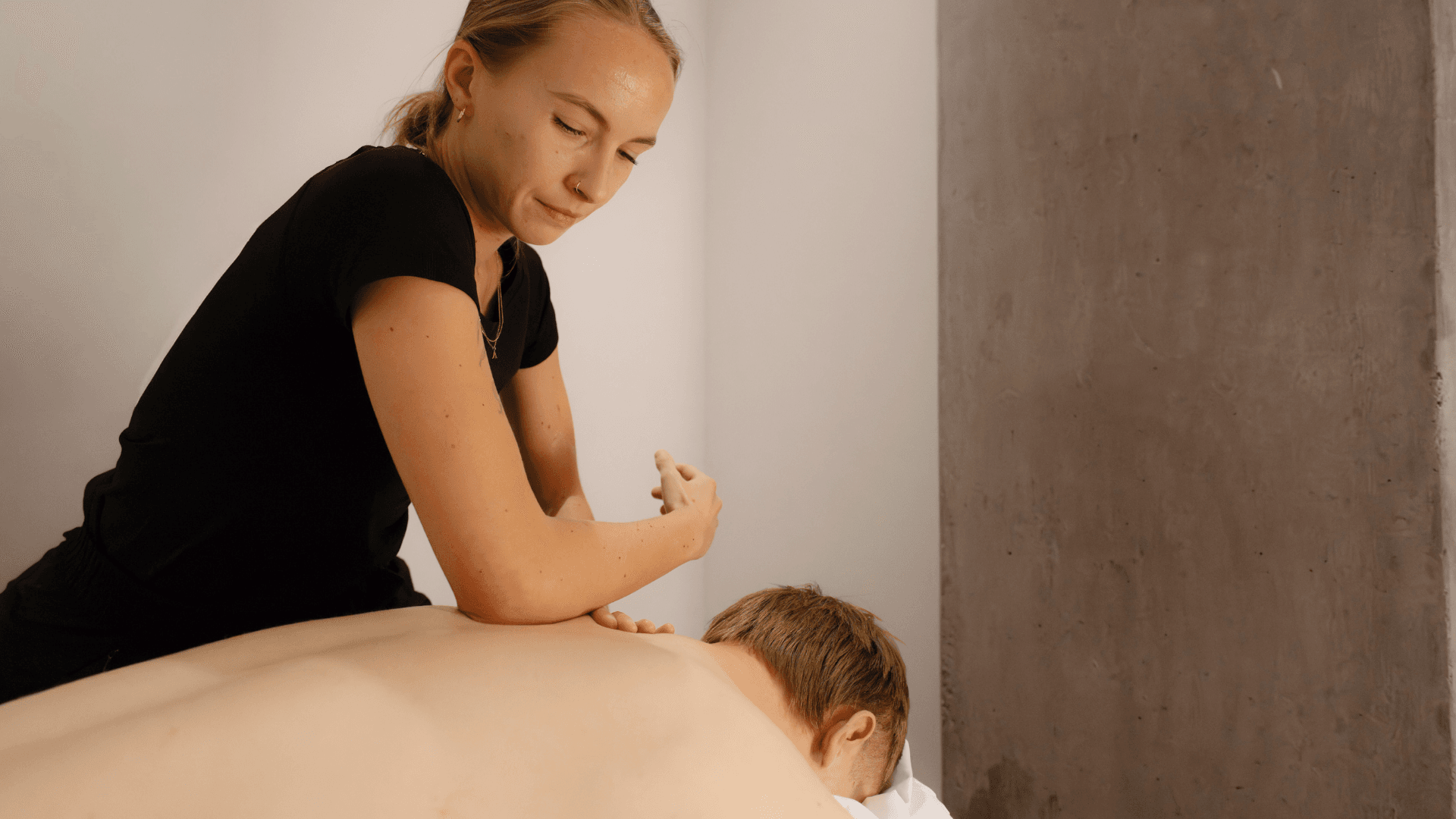
Your RMT addresses the physical component of the soft tissue system: the protective guarding in the cervical musculature, the tension in the suboccipital muscles that contributes to headaches, and the overall heightened state of the nervous system that often accompanies PCS. Skilled, gentle massage in the acute-to-subacute phase can significantly reduce headache frequency and cervical pain — making vestibular rehabilitation more tolerable and effective.
In post-concussion care, the RMT creates the physical conditions — reduced cervical tension, lower sympathetic tone — in which vestibular and cervical exercises can be performed with greater tolerance. They’re not parallel tracks; they’re a coordinated sequence.
Our Approach to Post-Concussion Syndrome
Pursuit’s vestibular rehabilitation clinicians are experienced in managing both the vestibular and cervical components of post-concussion syndrome. Our approach:
- Define Your Goal — return to sport, return to full cognitive work, driving without dizziness, sleeping without headaches. Your goal determines the rehabilitation milestones.
- Measure What Matters — standardized concussion assessment tools, cervical range of motion, vestibular function testing, balance metrics. We establish your baseline objectively and track it throughout.
- Personalized Pain Relief — manual therapy and dry needling to the cervical spine where indicated; gentle vestibular exercises calibrated to your current symptom threshold.
- Tailored Programming — your VRT and cervical rehab program is built around your specific findings. The exercises that work for a patient with primary dizziness are different from those for a patient whose main symptoms are headaches and cognitive fog.
- Retest Metrics — regular re-assessment to confirm your systems are improving and to progress the program appropriately. We don’t guess; we measure.
- Fitness For Life — the endpoint of PCS rehabilitation is not just symptom resolution. It’s restoring full function, confidence in movement, and the ability to return to everything that
Realistic Expectations for Post-Concussion Recovery
PCS recovery is highly variable. There is no universal timeline. What we can say with confidence from the evidence:
– Early physiotherapy intervention is associated with faster recovery
– Multimodal treatment (vestibular + cervical + visual-motor, tailored to your profile) outperforms single-modality approaches
– Active participation matters — the exercises prescribed between sessions are as important as the sessions themselves
– Most patients see meaningful improvement within 8–12 weeks of appropriate physiotherapy; some require longer
Recovery may not be linear. There will be weeks where symptoms flare — and that doesn’t mean you’ve gone backward. It means your nervous system is adapting, and the goal is to build tolerance progressively.
What Pursuit guarantees: an honest, thorough assessment; a treatment plan grounded in the current evidence; one-on-one time with a clinician who understands the complexity of this condition; and a team that will adapt your plan based on what the data shows. Your recovery from post-concussion syndrome is not predetermined.
Book a Post-Concussion Assessment in Victoria
If you’re dealing with symptoms that have persisted weeks or months after a head injury, don’t wait any longer. A thorough physiotherapy assessment is the starting point for understanding what systems are involved and building a plan to address them.
Pursuit Physiotherapy
102B–740 Hillside Ave, Victoria, BC
Free 60-minute parking directly outside. Transit accessible (Hillside Ave at Blanshard and Douglas St. bus stops).
Direct billing available for WSBC, ICBC and all major extended health insurers. No physician referral required.
References
-
Moser, N., Gargoum, S., Popovic, M.R., & Kalsi-Ryan, S. (2024). Effectiveness of Non-Pharmacological Therapy on Physical Symptoms in Patients With Persistent Concussion Symptoms: A Systematic Review. Journal of Neurotrauma. DOI: 10.1089/neu.2023.0474
-
Ferry, B., et al. (2023). Vestibular Rehabilitation as an Early Intervention in Athletes Who are Post-concussion: A Systematic Review. International Journal of Sports Physical Therapy. PMC10324323
-
Ellis, M.J., et al. (2021). Sequencing and Integration of Cervical Manual Therapy and Vestibulo-oculomotor Therapy for Concussion Symptoms: Retrospective Analysis. International Journal of Sports Physical Therapy. PMC7872443
-
Patricios, J.S., et al. (2023). Consensus statement on concussion in sport: the 6th International Conference on Concussion in Sport — Amsterdam. British Journal of Sports Medicine.
-
Reed, N., et al. (2023). Complexity of post-concussion syndrome assessment and management: a case for customizing rehabilitation. PMC12032806