Calf tightness when running is a common complaint among runners and athletes. Whether it appears during longer runs, hill sessions, sprinting, or the day after a hard workout, it is often managed with calf stretching, foam rolling, or rest.
While these strategies can be helpful, there may be another piece of the puzzle worth considering: big-toe mobility and how the foot works with the calf during movement. Understanding this connection may help identify contributing factors behind recurring calf tightness when running.
How Is Big-Toe Mobility Connected to Calf Tightness When Running?
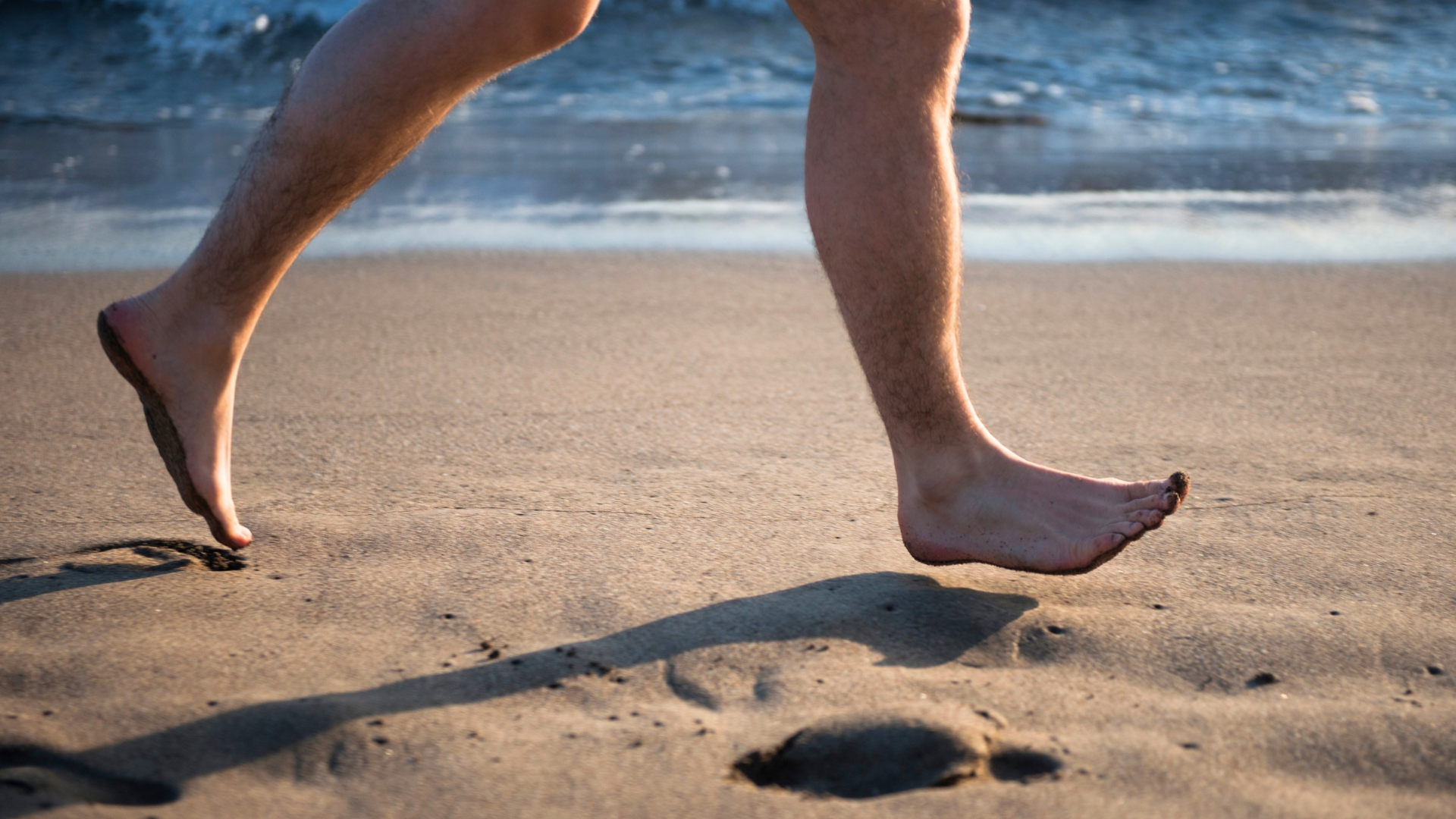
During running, the big toe extends as the body moves forward over the foot and prepares for push-off. This movement contributes to the *windlass mechanism*, whereby tension develops in the plantar fascia, influencing the behaviour of the foot’s arch [1].
Research has shown that toe movement, arch mechanics, and plantar fascia loading change during running, with differences depending on running technique [2]. The foot is therefore not simply a passive structure; it plays an important role in absorbing, transferring, and generating force.
The calf muscles, particularly the gastrocnemius and soleus, work alongside the Achilles tendon to support the body and contribute to propulsion. Other muscles, including the flexor hallucis longus, connect lower-leg function with movement and control of the big toe.
When big-toe mobility is restricted, an athlete may adapt how they load the forefoot or push off. These changes could influence how forces are distributed through the foot and ankle, potentially altering the demands placed on the calf. For runners experiencing recurring calf tightness when running, big-toe mobility may be one contributing factor worth assessing.
Toe mobility is one possible contributing factor to consider alongside training load, muscle capacity, ankle mobility, and recovery.
Signs of Calf Tightness When Running: What Should You Look Out For?
Toe mobility may be worth assessing if you experience recurring calf tightness, particularly when it occurs alongside:
- Difficulty extending the big toe comfortably.
- A feeling of stiffness through the forefoot during walking or running.
- Symptoms that repeatedly appear during hills, acceleration, or longer runs.
- Persistent calf tightness despite regularly stretching the calf muscles.
These signs do not necessarily mean that restricted toe mobility is the cause. They simply highlight why assessing the whole foot-and-ankle system can provide a more complete picture.
How can physiotherapy help?
A physiotherapist can assess how your foot, ankle, and calf work together, rather than focusing exclusively on the area where you feel tightness.
Depending on your assessment findings, treatment may include:
- Big-toe mobility exercises to address relevant restrictions in comfortable joint range.
- Foot-muscle strengthening to improve muscular control and support foot function.
- Progressive calf strengthening to build the capacity needed for running, jumping, and sprinting.
- Running and training-load adjustments to help manage the demands placed on your lower limbs.
Research suggests that intrinsic foot muscle strengthening can improve selected measures of foot function, although the evidence is still developing [3,4].
The goal is not simply to increase flexibility. It is to identify the factors contributing to your symptoms and improve your ability to tolerate the demands of your sport.
The Takeaway: Understanding Calf Tightness When Running
Your calves don’t work in isolation. Big-toe mobility, plantar fascia mechanics, foot strength, and ankle function all contribute to how your lower limb moves and manages load.
If you experience recurring calf tightness when running, it may be worth looking beyond the calf itself. A physiotherapy assessment can help identify whether restricted toe mobility or other foot and ankle factors are contributing to your symptoms, and guide an individualised plan to help you move, train, and run with confidence.
Book an Assessment at Pursuit
Pursuit Physiotherapy
📍 102B–740 Hillside Ave, Victoria, BC
🚗 Free 60-minute parking on site, and easily accessible by transit
📅 Book online: pursuitphysiotherapy.janeapp.com
📞 (250) 363-9707
✉️ info@pursuitphysiotherapy.ca
No referral needed — direct billing available to all major extended health insurers
References
- Sichting F, Ebrecht F. The rise of the longitudinal arch when sitting, standing, and walking: contributions of the windlass mechanism. PLoS One. 2021;16(4):e0249965. doi:10.1371/journal.pone.0249965.
- Sun X, Su W, Zhang F, et al. Changes of the in vivo kinematics of the human medial longitudinal foot arch, first metatarsophalangeal joint, and the length of plantar fascia in different running patterns. Front Bioeng Biotechnol. 2022;10:959807. doi:10.3389/fbioe.2022.959807.
- Jaffri AH, Koldenhoven R, Saliba S, Hertel J. Evidence for intrinsic foot muscle training in improving foot function: a systematic review and meta-analysis. J Athl Train. 2023;58(11-12):941-951. doi:10.4085/1062-6050-0162.22.
- Ahmed M, Zaki S, Alam MF, et al. The impact of intrinsic foot muscle strengthening exercises in asymptomatic athletes with normal foot structure: a systematic review. Clin Epidemiol Glob Health. 2024;27:101597. doi:10.1016/j.cegh.2024.101597.