A clear, evidence-based look at shockwave therapy in Victoria BC — including extracorporeal shockwave therapy (ESWT), what it helps, what it doesn’t, and how it fits into active rehab at our Victoria, BC clinic.
If you’ve had heel pain, a cranky Achilles, or a stubborn shoulder that just won’t settle, you’ve probably heard the word “shockwave.” It sounds dramatic. In Victoria, BC, more clinics now offer shockwave therapy Victoria BC, and patients often ask us whether it’s worth trying.
Here’s the honest answer this guide unpacks: shockwave therapy in Victoria BC is a genuinely useful tool for certain stubborn tendon problems — but it’s not magic, and it works best as part of an active plan, not instead of one. Let’s look at what extracorporeal shockwave therapy actually does, where the evidence is strong, and where it’s mixed.
What is shockwave therapy?
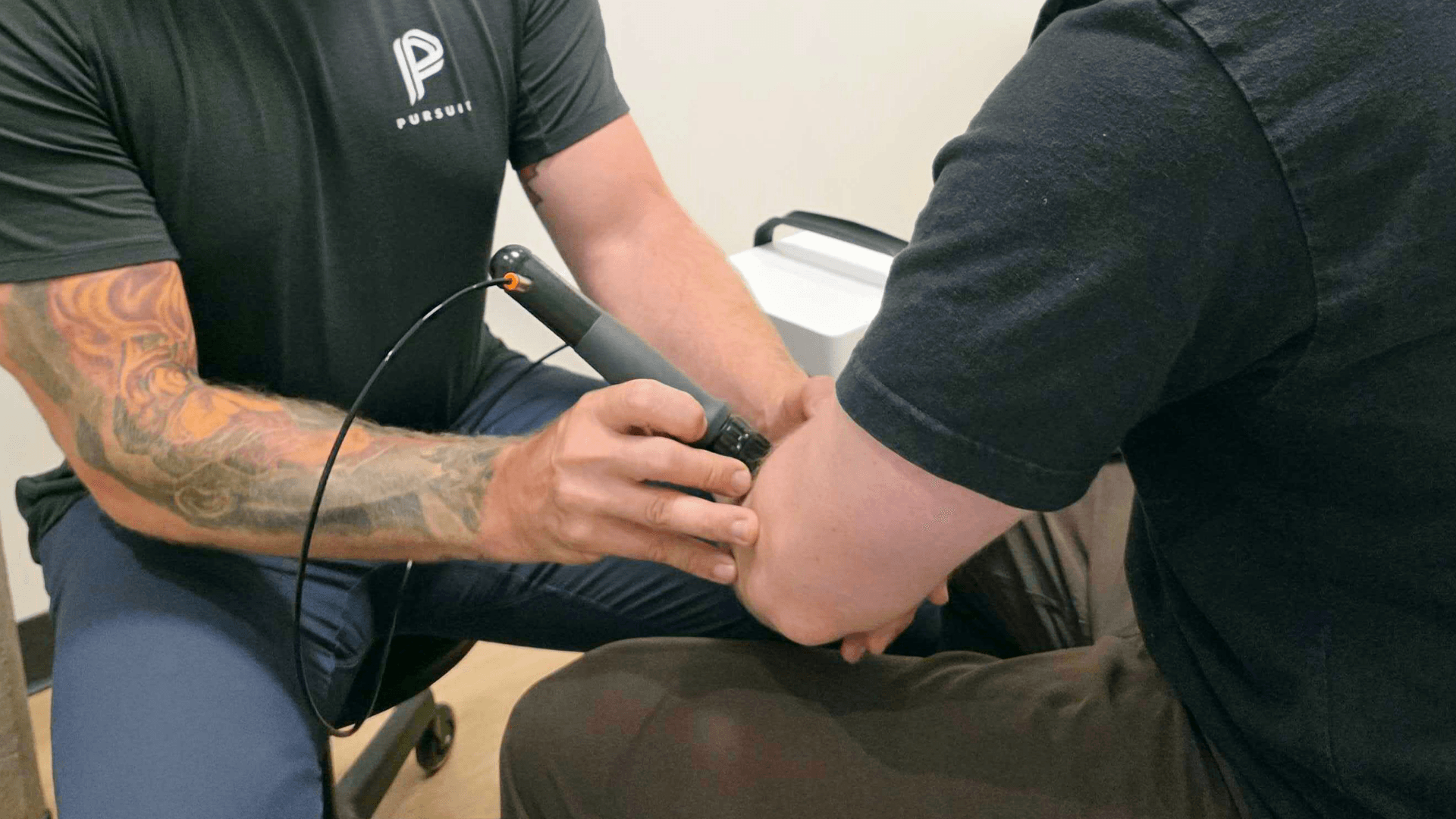
Extracorporeal shockwave therapy — usually shortened to ESWT — delivers high-energy acoustic (sound) pressure waves into an injured area through the skin. “Extracorporeal” simply means the energy is generated outside the body and directed inward.
The waves are thought to stimulate a healing response in tissue that has stalled. In chronic tendon problems, the body’s repair process can get stuck. The theory is that controlled mechanical stress “restarts” it — encouraging new blood vessel growth, cellular activity, and remodelling.
There are two broad types. Focused ESWT delivers energy deeper and more precisely. Radial ESWT spreads energy over a broader, more superficial area. Which one suits you depends on the tissue and the target.
Research Stat: A 2024 systematic review and meta-analysis found that ESWT reduced pain significantly more than placebo across a range of tendinopathies — though the size of the benefit varied by condition and study quality. Source: various-tendinopathies meta-analysis, BMC Sports Science, Medicine and Rehabilitation, 2024. DOI: 10.1186/s13102-024-00884-8.
What shockwave therapy treats well
Shockwave isn’t a general pain eraser. Its best evidence sits with specific, chronic, load-related tendon and fascia problems that haven’t responded to time and basic care.
Plantar fasciitis (stubborn heel pain)
This is one of the strongest use-cases. For heel pain that has lingered for months, shockwave has repeatedly outperformed placebo.
A 2024 systematic review with meta-analysis and meta-regression concluded that ESWT was effective and well tolerated for plantar fasciopathy, improving pain compared with sham treatment.
Source: Lippi et al., European Journal of Physical and Rehabilitation Medicine, 2024. PubMed ID: 39257331.
If heel pain is your issue, our ankle and foot pain resources cover the wider picture, and footwear or orthotics may play a supporting role.
Calcific tendinopathy of the shoulder
When a painful calcium deposit forms in the rotator cuff, shockwave is a well-studied non-surgical option.
A 2024 systematic review with meta-analysis found ESWT improved pain and function for rotator cuff calcific tendinopathy, and could help break down the calcification.
Source: Brindisino et al., Physiotherapy Research International, 2024. DOI: 10.1002/pri.2106.
Tennis elbow (lateral epicondylitis)
For the persistent outer-elbow pain of tennis elbow, shockwave is a reasonable option when first-line loading hasn’t been enough. Our team already treats this condition.
Where the evidence is more mixed
Intellectual honesty is part of how we practise, so here’s the other side of shockwave therapy in Victoria BC.
For midportion Achilles tendinopathy, the evidence is genuinely inconclusive. Some studies show benefit; others find shockwave therapy no better than other conservative care. It may help certain people, but it isn’t a guaranteed answer.
Across tendon conditions generally, the quality of evidence varies, and the average benefit over placebo is sometimes modest. Shockwave therapy Victoria BC patients should know that while ESWT is a legitimate tool for certain conditions, it is not a miracle treatment. Anyone promising a one-and-done cure is overselling it.
The critical point: shockwave supports active rehab, it doesn’t replace it
This is where our approach at Pursuit matters most. Shockwave is a passive treatment — something done to you. And on its own, passive treatment doesn’t build the strength and load capacity a tendon needs to stay healthy.
The most reliable, evidence-based treatment for chronic tendon pain is progressive loading — carefully graded strengthening that rebuilds the tendon’s tolerance. Shockwave earns its place by turning down pain enough that you can do that loading work sooner and more comfortably.
To be clear about what we do and don’t use: Pursuit does not offer ultrasound, IFC, TENS, or laser therapy. Those passive modalities don’t build tissue capacity, so we’ve chosen not to use them. Shockwave is different — it has a specific, evidence-supported role for particular conditions, and we use it as a bridge into active rehab, never as a substitute for it.
Pursuit Philosophy: Quality care over quick fixes. Shockwave can open a window by reducing pain. Progressive loading is what walks you through it to a durable result — so we never use one without the other.
How shockwave fits into care at Pursuit
At Pursuit, shockwave therapy is delivered by our chiropractor as one part of an integrated, team-based plan — not as a standalone service you book in isolation. That coordination is deliberate.
Your care team maps out the sequence together. The physiotherapist assesses the tendon, measures your baseline strength and function, and builds the loading program. Shockwave is applied when it will help most — typically to reduce pain so you can progress your exercises. Everything is retested so we know it’s working.
The role of massage therapy
Our registered massage therapists (RMTs) add another layer. Hands-on work reduces protective muscle tone around an irritable area and improves circulation, creating a short window where you move more freely and your loading program lands better.
The Integration Principle: Shockwave calms the tendon. Massage therapy relaxes the surrounding tissue. Loading rebuilds capacity. Coordinated, these do more together than any one does alone.
Source: Guo et al., Frontiers in Physiology, 2017. DOI: 10.3389/fphys.2017.00747.
A quick coverage note: shockwave and chiropractic visits may be covered by your extended health plan. If your injury relates to a motor vehicle accident, coverage depends on your specific ICBC claim and adjuster approval — our front desk can help you check before you start.
The Pursuit approach to stubborn tendon pain
We treat tendon pain the way we treat everything — one-on-one, measured, and built around your goal. No assembly line, no generic handout.
For a typical stubborn tendon problem, care might include:
- A thorough assessment to confirm the diagnosis and rule out other causes
- Objective baseline measures — strength, range, and function — that we retest over time
- A progressive loading program tailored to your tendon and your life
- Shockwave therapy where the evidence supports it, timed to enable your loading
- Coordinated massage therapy when it will help you move and train better
- Guidance on footwear, activity, and — for lower-limb cases — custom orthotics when relevant
The endpoint isn’t just less pain. It’s a tendon that can handle your life again — fitness for life, not a temporary patch.
Realistic Expectations about Shockwave Therapy
Shockwave usually involves a short series of sessions, often spaced about a week apart, and it can be briefly uncomfortable during application. Results build over weeks, not overnight, and they hold best when paired with loading.
We won’t promise a specific number of sessions or guarantee a particular result — the evidence doesn’t support that kind of certainty, and neither will we. What we do promise: a careful assessment, an honest read on whether shockwave is likely to help you, an evidence-based plan, and a team that adjusts as your body responds. Recovery isn’t always linear, but it also isn’t predetermined.
Ready to Ride Comfortably Again
Wondering whether shockwave therapy is right for your stubborn heel, shoulder, or elbow? The first step is an assessment to confirm what’s actually going on — because shockwave only helps when it’s the right tool for the right problem.
Pursuit Physiotherapy
📍 102B–740 Hillside Ave, Victoria, BC
🚗 Free 60-minute parking on site, and easily accessible by transit
📅 Book online: pursuitphysiotherapy.janeapp.com
📞 (250) 363-9707
✉️ info@pursuitphysiotherapy.ca
No referral needed — direct billing available to all major extended health insurers
Let’s find out whether shockwave belongs in your plan — and build the active program that makes it stick. Welcome to Rehab Reimagined.
References
- Various-tendinopathies pain meta-analysis. The effect of extracorporeal shock-wave therapy on pain in patients with various tendinopathies: a systematic review and meta-analysis of randomized controlled trials. BMC Sports Science, Medicine and Rehabilitation. 2024. DOI: 10.1186/s13102-024-00884-8.
- Lippi L, et al. Efficacy and tolerability of extracorporeal shock wave therapy in patients with plantar fasciopathy: a systematic review with meta-analysis and meta-regression. European Journal of Physical and Rehabilitation Medicine. 2024. PubMed ID: 39257331
- Brindisino F, et al. The effectiveness of extracorporeal shock wave therapy for rotator cuff calcific tendinopathy: a systematic review with meta-analysis. Physiotherapy Research International. 2024. DOI: 10.1002/pri.2106.
- Midportion Achilles tendinopathy systematic review. The Effectiveness of Extracorporeal Shockwave Therapy for Midportion Achilles Tendinopathy: A Systematic Review. 2022. PubMed ID: 35989757.
- Guo J, Li L, Gong Y, et al. Massage Alleviates Delayed Onset Muscle Soreness after Strenuous Exercise: A Systematic Review and Meta-Analysis. Frontiers in Physiology. 2017;8:747. DOI: 10.3389/fphys.2017.00747.