
How to build toward the Royal Victoria Marathon without breaking down — what the research actually says about marathon training, injury prevention, and staying healthy, from a Victoria, BC physiotherapy team.
The Royal Victoria Marathon lands on Thanksgiving Sunday, October 11, 2026. That means the next ten weeks are the ones that can make or break race day.
Here’s the hard truth most marathon training plans skip: the biggest threat to your race isn’t your fitness. It’s an injury you could have prevented. This guide walks through what the evidence says about marathon training injury prevention — and how load, strength, and smart recovery can keep you on the Galloping Goose instead of on the couch.
Why runners get hurt in the build-up
Most running injuries aren’t bad luck. They’re the body reacting to load it wasn’t ready for. During marathon training, when training volume climbs faster than your tissues can adapt, tendons, bone, and muscle start to complain.
The classic advice was the “10% rule” — never increase weekly mileage by more than 10%. It’s a reasonable starting point, but newer research suggests weekly totals aren’t where the real risk lives. The danger hides in single sessions that spike too far, too fast.
A large cohort study followed 5,205 runners across more than half a million running sessions. Injury risk jumped when a single run went more than 10% beyond the runner’s longest run in the previous 30 days.
Research Stat: In a 5,205-runner cohort, injury rates rose with each “spike” in a single session’s distance: a 64% higher rate for spikes of 10–30% (HRR 1.64), and more than double the rate for spikes over 100% (HRR 2.28), compared with runs that stayed within 10% of the prior month’s longest run.
Source: Nielsen et al., *British Journal of Sports Medicine*, 2025.
The takeaway for your marathon training build is simple: progress your long run gradually. A single heroic weekend — jumping from 18 to 30 kilometres because you feel great — is exactly the kind of spike that can end a training block.
The three most common marathon training injuries
When Victoria runners come into the clinic mid-build, the same handful of problems show up again and again:
Runner’s knee (patellofemoral pain)
The aching at the front of the knee, worse on hills and stairs.
IT band syndrome
The sharp pain on the outside of the knee that appears at a predictable point in a run.
Achilles and calf overload, shin splints, and bone stress
Load-related pain in the lower leg that tends to build over weeks.
Almost all of these are overuse injuries. They share a root cause — training load rising faster than tissue capacity — which is exactly why they respond to the same prevention principles.
Strength training is your best insurance policy
If you do one thing beyond running to protect your race during marathon training, make it strength work. This is one of the most consistent findings in sports medicine.
A landmark systematic review and meta-analysis of 25 randomised controlled trials found that strength training reduced overuse injuries markedly and cut acute injury rates too. Stretching, by contrast, showed no meaningful protective effect.
Research Stat: A meta-analysis of controlled trials found strength training reduced sports overuse injuries to roughly a third to a half of the rate seen without it — a larger protective effect than stretching or proprioception work. Source: Lauersen et al., British Journal of Sports Medicine, 2014. DOI: 10.1136/bjsports-2013-092538.
A follow-up analysis suggested the effect is dose-dependent — more consistent strength work, up to a point, meant fewer injuries.
Source: Lauersen et al., British Journal of Sports Medicine, 2018. DOI: 10.1136/bjsports-2018-099078.
For runners preparing for a marathon, that means including two short sessions a week of loaded, lower-body strength work as part of your marathon training plan: squats, hip and calf strengthening, and single-leg control. It doesn’t make you bulky or slow. It builds the tissue capacity needed to absorb increasing mileage, handle long runs, and stay healthy through race day.
Load, recover, repeat: the rhythm that keeps you healthy during marathon training
Adaptation happens during recovery, not during the run. Your body needs time between hard efforts to rebuild stronger than before. Skip that, and you’re just accumulating damage.
Three habits protect the recovery side of the equation:
- Keep long-run jumps modest. Aim to keep each long run within roughly 10% of your longest run from the past month.
- Respect easy days. Most of your weekly kilometres should feel genuinely easy. Hard-every-day is how tissues get overwhelmed.
- Sleep and fuel. These aren’t extras. They’re where tendon and bone repair actually happens.
If you’re unsure whether your shoes or running mechanics are adding load in the wrong places, a running assessment can pinpoint it before it becomes pain. For some runners, footwear or custom orthotics change how load is distributed — though these are one tool among several, not a fix on their own.
What Actually Builds a Resilient Runner During Marathon Training
When something starts to niggle, it’s tempting to look for a passive fix — a machine, a gadget, or something done to you while you lie there. But understanding active vs. passive treatment is important when it comes to building long-term running resilience.
Passive treatments alone don’t build tissue capacity. That’s the quality your running load demands, and it’s something only active work can develop. Pursuit deliberately does not use ultrasound, IFC, TENS, or laser therapy. That’s not a gap in our services — it’s an evidence-based choice. These modalities don’t build the strength, coordination, or load tolerance a runner needs to handle increasing mileage.
Active rehabilitation does. It means assessment, education, and progressive loading tailored to where your body is right now. The same principles that help prevent injuries — strength, consistency, and graded exposure — are also what help resolve them.
Pursuit Philosophy: Quality care over quick fixes. A machine can’t teach your tendons, muscles, and joints to handle 42.2 kilometres. Progressive, individualised loading can — and that’s what we build with every runner.
The Pursuit Approach to Supporting Your Marathon Training
Rehab and injury prevention aren’t a solo act. At Pursuit, our physiotherapists, chiropractors, and registered massage therapists (RMTs) work from a shared plan — because coordinated care often creates better outcomes than isolated treatments.
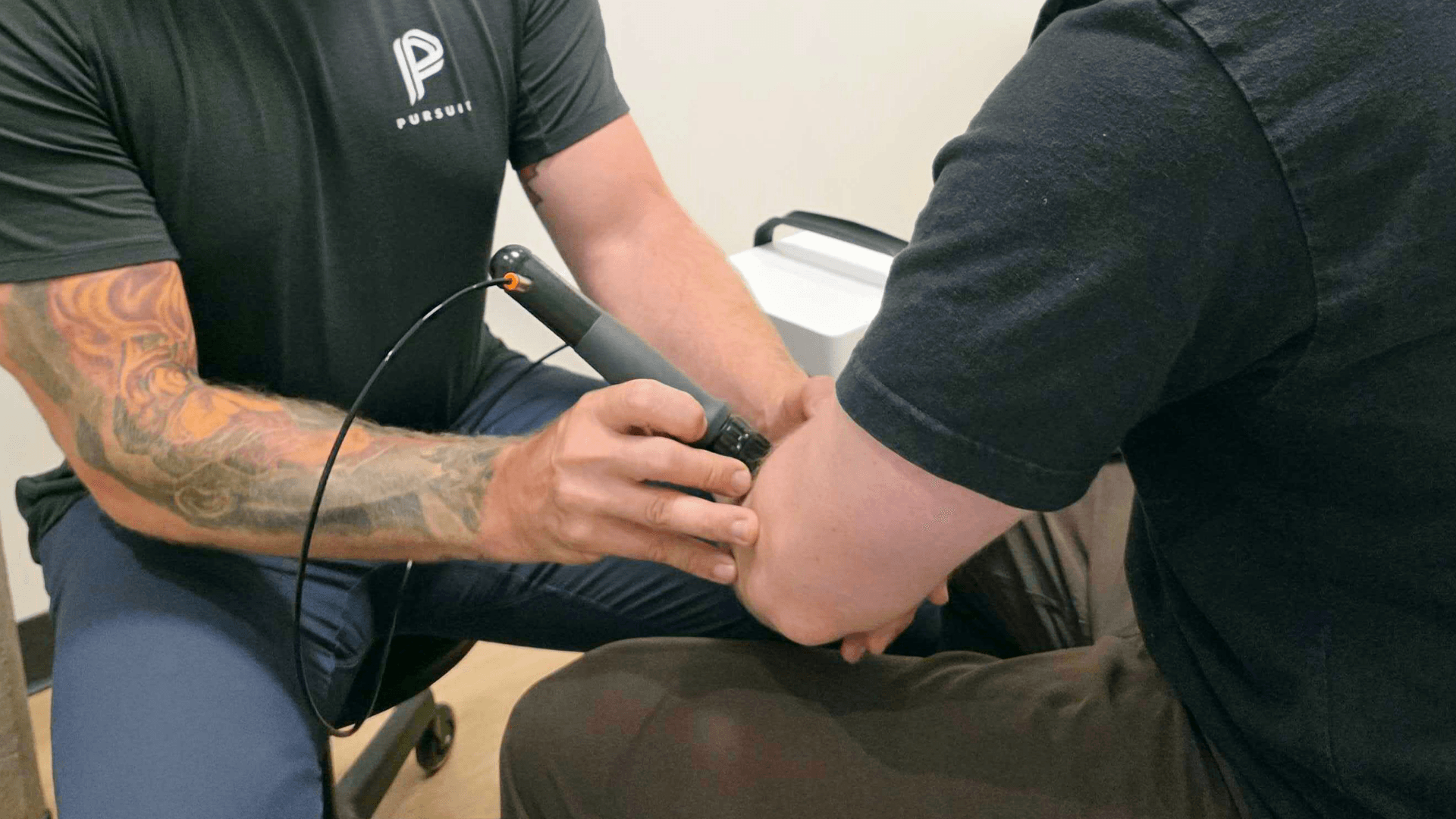
The physiotherapist assesses your movement, measures strength and range of motion, prescribes your progressive loading program, and retests to make sure your training is moving in the right direction. Chiropractic care can complement this approach by addressing joint mobility, movement restrictions, and areas that may be limiting how efficiently your body moves during running. The RMT helps prepare the tissue by reducing protective muscle tone, improving comfort, and creating a short window where your body can move more freely and respond better to active rehabilitation.
Think of it as preparing the ground and planting the seeds. Massage and hands-on care help create the right environment; the strength and loading program is what actually builds capacity. Chiropractic, physiotherapy, and RMT each play a role — but the active work is what allows your body to adapt to the demands of marathon training.
The Integration Principle: Massage therapy creates the window. Chiropractic and physiotherapy help optimise movement. Active loading walks you through it. Combined, coordinated care beats any single approach on its own — which is why our physio, chiropractic, and RMT teams plan together.
Source: Guo et al., Frontiers in Physiology, 2017. DOI: 10.3389/fphys.2017.00747.
Keeping runners running
Every runner who trains with us gets one-on-one time — no assembly line, no shared appointments. We start by defining your goal, whether that’s a Boston qualifier or simply crossing the Inner Harbour finish line healthy.
Then we measure what matters: strength, single-leg control, calf capacity, and running mechanics. From there, care is built for you and retested as you go:
- A graded strength program targeting the hips, knees, and calves that take marathon load
- Training-load guidance so your long runs progress without spiking
- Gait and footwear review through a running assessment when it’s relevant
- Hands-on work and, where useful, coordinated RMT sessions
The goal isn’t just to get you to the start line. It’s fitness for life — a body that keeps running long after October 11.
Reality of Marathon Training: Progress, Recovery, and Staying Healthy
Let’s be honest about what prevention can and can’t do. Smart training dramatically lowers your risk, but no plan drops it to zero. Recovery from a niggle isn’t always linear either — some weeks feel better than others, and that’s normal.
What we won’t do is promise a specific number of sessions or guarantee a finish time. What we do guarantee is a thorough assessment, honest communication, an evidence-based plan, and a team that adjusts as your body responds. Your race is not predetermined by today’s soreness. With the right load management, most runners get to the line ready.
Book your pre-race check at Pursuit
If something’s nagging — or you’d rather catch it before it starts — now is the time, not race week. A focused assessment in the next few weeks gives you room to adjust.
No referral needed — direct billing available to ICBC and all major extended health insurers
📍 102B–740 Hillside Ave, Victoria, BC
🚗 Free 60-minute parking on site, and easily accessible by transit
📅 Book online: pursuitphysiotherapy.janeapp.com
📞 (250) 363-9707
✉️ info@pursuitphysiotherapy.ca
Train smart, recover well, and we’ll see you at the finish. Welcome to Rehab Reimagined.
References
- Nielsen RØ, et al. How much running is too much? Identifying high-risk running sessions in a 5200-person cohort study. British Journal of Sports Medicine. 2025.
- Lauersen JB, Bertelsen DM, Andersen LB. The effectiveness of exercise interventions to prevent sports injuries: a systematic review and meta-analysis of randomised controlled trials. British Journal of Sports Medicine. 2014;48(11):871–877. DOI: 10.1136/bjsports-2013-092538.
- Lauersen JB, Andersen TE, Andersen LB. Strength training as superior, dose-dependent and safe prevention of acute and overuse sports injuries: a systematic review, qualitative analysis and meta-analysis. British Journal of Sports Medicine. 2018;52(24):1557–1563. DOI: 10.1136/bjsports-2018-099078.
- Guo J, Li L, Gong Y, et al. Massage Alleviates Delayed Onset Muscle Soreness after Strenuous Exercise: A Systematic Review and Meta-Analysis. Frontiers in Physiology. 2017;8:747. DOI: 10.3389/fphys.2017.00747.