There are several knee injury types, with ligament injuries being among the most common seen in sport and active populations. The anterior cruciate ligament (ACL), medial collateral ligament (MCL), and lateral collateral ligament (LCL) each play a critical role in maintaining knee stability. While injury severity and treatment requirements vary, contemporary evidence supports an active, rehabilitation-focused approach to recovery, with surgery reserved for selected cases.[1-5]
ACL (Anterior Cruciate Ligament) Injuries
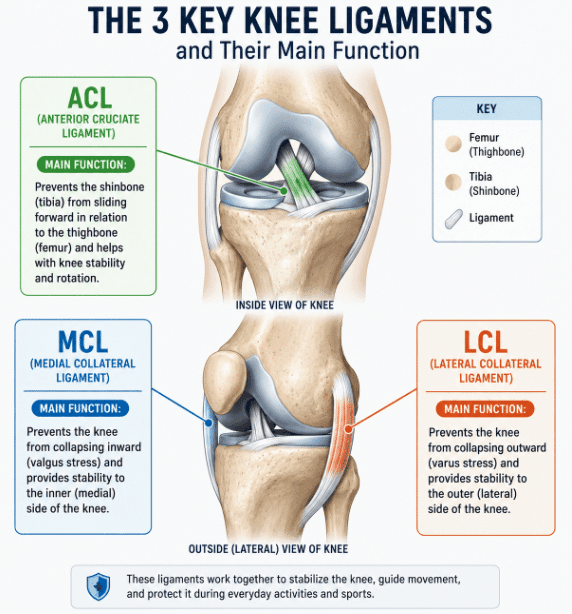
The ACL provides restraint against anterior translation (shin bone sliding too far forward in front of the thigh bone) and provides rotational stability of the tibia. ACL injuries commonly occur during pivoting, cutting, or landing movements and often present with an audible “pop,” swelling, and instability.[8]
Current management emphasizes early restoration of knee extension, reduction of swelling, progressive strength training, neuromuscular rehabilitation, and psychological readiness.[8] Not all ACL tears require reconstruction; some individuals can achieve satisfactory function with structured rehabilitation alone.[8] For those undergoing reconstruction, return-to-sport decisions should be based on functional testing and strength symmetry rather than time alone.[8]
Evidence suggests that returning to pivoting sports before adequate strength and functional recovery increases the risk of reinjury.[8] Consequently, modern rehabilitation protocols favour a criteria-based progression, with unrestricted return to high-demand sport often occurring between 9-12 months following reconstruction.[8]
MCL (Medial Collateral Ligament) Injuries
The MCL is the most frequently injured knee ligament and resists valgus (outward) stress, which pushes the knees inward toward the midline of the body. Most isolated grade I and grade II MCL injuries heal successfully without surgery.[1,2]
Current recommendations include early protected movement, progressive weight-bearing as tolerated, quadriceps strengthening, and neuromuscular training.[1,2] Functional bracing may be used during the early recovery phase for higher-grade injuries.[1,2] Surgical management is generally reserved for severe grade III injuries, persistent instability, or complex multiligament injuries.[1,3]
Recovery timelines vary according to severity, but many patients with isolated low-grade MCL injuries return to normal activities within weeks to months when guided by structured rehabilitation.[1,2]
LCL (Lateral Collateral Ligament) Injuries
The LCL provides resistance to varus (inward) stress which pushes the knee joint outwards from the body, and aids with rotational stability. Isolated LCL injuries are less common than MCL injuries but may result in significant functional impairment.[4,5]
Management depends on injury severity. Low-grade isolated injuries are frequently managed conservatively with bracing, progressive loading, and rehabilitation.[4] However, higher-grade LCL injuries often demonstrate poorer outcomes with non-operative treatment and may require surgical reconstruction to restore knee stability.[4,5]
Rehabilitation focuses on restoring range of motion, lower-limb strength, balance, and movement control while protecting healing tissues from excessive varus and rotational forces.[4-6]
Key Recovery Principles Across All Knee Injury Types
Current best practice supports:
- Early, guided rehabilitation rather than prolonged immobilization.[1,2,8]
- Progressive strengthening of the quadriceps, hamstrings, gluteal, and calf muscles.[1,2,8]
- Neuromuscular and balance training to improve joint stability.[1,2,8]
- Gradual return to running, jumping, and sport-specific activities.[2,8]
- Criteria-based return-to-sport decisions using strength, functional testing, and symptom response.[2,8]
- Ongoing exercise participation to reduce reinjury risk and support long-term joint health.[2,8]
Recovery is highly individual and depends on injury severity, associated damage (e.g., meniscal injury), treatment approach, age, activity demands, and adherence to rehabilitation.[1-8]
Pursuit Approach to Knee Injuries
At Pursuit, knee injury rehabilitation is built around more than just reducing pain. Every treatment plan is guided by a comprehensive assessment and objective measures to help you recover safely, restore confidence, and get back to doing what you love.
Define Your Goal — what does recovery look like for you? Returning to running? Getting back on the soccer field? Hiking without pain? Climbing stairs confidently? Your treatment starts with understanding what matters most to you.
Measure What Matters — before treatment begins, we establish baseline measurements such as range of motion, swelling, strength, balance, stability, and functional movement. These metrics are reassessed throughout your rehabilitation to ensure you’re making meaningful progress.
Personalized Recovery Plan — no two knee injuries are the same. Whether you’ve injured your ACL, MCL, or LCL, your treatment is tailored to the specific tissues involved, the severity of your injury, and your individual goals.
Progressive Rehabilitation — as your knee heals, your exercise program evolves with you. We focus on restoring strength, mobility, balance, and movement quality while gradually preparing you to return to work, sport, or everyday activities.
Track Your Progress — your recovery isn’t based on guesswork. We continually reassess your strength, function, and movement to make sure your treatment is producing measurable improvements and adjust your plan as needed.
Return With Confidence — the goal isn’t simply to reduce knee pain—it’s to help you move with confidence, reduce your risk of re-injury, and get back to the activities you enjoy for the long term.
Conclusion
Modern management of ACL, MCL, and LCL injuries has shifted away from passive rest toward active, evidence-based rehabilitation. Most isolated MCL injuries recover successfully without surgery, while ACL and higher-grade LCL injuries may require reconstruction in selected patients.[1-5,8]
Regardless of treatment pathway, progressive exercise rehabilitation remains the cornerstone of successful recovery and safe return to activity.
Book a Knee Injury Assessment in Victoria
If you’re dealing with ongoing knee pain, swelling, instability, or difficulty moving after a knee injury, don’t wait for it to improve on its own. A comprehensive physiotherapy assessment can identify the structures involved and create a personalized treatment plan to help you recover safely and regain strength, mobility, and confidence.
Pursuit Physiotherapy
102B–740 Hillside Ave, Victoria, BC
Free 60-minute parking directly outside. Transit accessible (Hillside Ave at Blanshard and Douglas St. bus stops).
Direct billing available for WSBC, ICBC and all major extended health insurers. No physician referral required.
References
- Vosoughi F, Rezaei Dogahe R, Nuri A, Ayati Firoozabadi M, Mortazavi J. Medial Collateral Ligament Injury of the Knee: A Review on Current Concept and Management. Arch Bone Jt Surg. 2021;9(3):255-262. doi: 10.22038/abjs.2021.48458.2401.
- Svantesson J, Piussi R, Weissglas E, et al. Shedding light on the non-operative treatment of the forgotten side of the knee: rehabilitation of medial collateral ligament injuries—a systematic review. BMJ Open Sport Exerc Med. 2024;10:e001750. doi: 10.1136/bmjsem-2023-001750
- Shultz CL, Poehlein E, Morriss NJ, Green CL, Hu J, Lander S, et al. Nonoperative management, repair, or reconstruction of the medial collateral ligament in combined anterior cruciate and medial collateral ligament injuries—Which is best? A systematic review and meta-analysis. Am J Sports Med. 2024;52(2):560–571. doi:10.1177/03635465231153157.
- Figueroa F, Figueroa D, Putnis S, Guiloff R. Posterolateral corner knee injuries: a narrative review. EFORT Open Rev. 2021;6(8):676–685. doi:10.1302/2058-5241.6.200096.
- Weiss S, Krause M, Frosch KH. Posterolateral corner of the knee: a systematic literature review of current concepts of arthroscopic reconstruction. Arch Orthop Trauma Surg. 2020;140:2003–2012. doi:10.1007/s00402-020-03607-z.
- Morris BL, Poppe T, Kim K, Barnds B, Schroeppel P, Mullen S, et al. Weightbearing protocols after posterolateral corner reconstruction: a systematic review. Orthop J Sports Med. 2021;9(3):2325967120988274. doi:10.1177/2325967120988274.
- Ardern CL, Ekås GR, Grindem H, Moksnes H, Anderson AF, Chotel F, et al. 2018 International Olympic Committee consensus statement on prevention, diagnosis and management of paediatric anterior cruciate ligament injuries. Br J Sports Med. 2018;52(7):422–438. doi:10.1136/bjsports-2017-098884.
- van Melick N, van Cingel REH, Brooijmans F, Neeter C, van Tienen T, Hullegie W, et al. Evidence-based clinical practice update: practice guidelines for anterior cruciate ligament rehabilitation based on a systematic review and multidisciplinary consensus. Br J Sports Med. 2016;50(24):1506–1515. doi:10.1136/bjsports-2015-095898.