Falls are the leading cause of injury among older Canadians — but they are not an inevitable part of aging. High-certainty research shows the right exercise program meaningfully reduces falls. Here’s what the evidence says, and how balance physiotherapy in Victoria BC puts it to work.
The Health Risk Nobody Wants to Talk About
Victoria is one of the best cities in Canada to grow older in. Mild winters, walkable neighbourhoods, the Dallas Road waterfront, Beacon Hill Park, a coffee shop on every corner worth walking to. Staying active here isn’t a chore — it’s the whole point of living here.
Which is exactly why falls prevention for seniors deserves more honest conversation than it usually gets. Most people will talk freely about their knee arthritis or their blood pressure. Far fewer will mention that they’ve started holding the railing differently, avoiding curbs after dark, or feeling a flutter of uncertainty stepping off the bus. That quiet shrinking of confidence often starts years before a fall ever happens — and it’s precisely the stage where the most can be done about it.
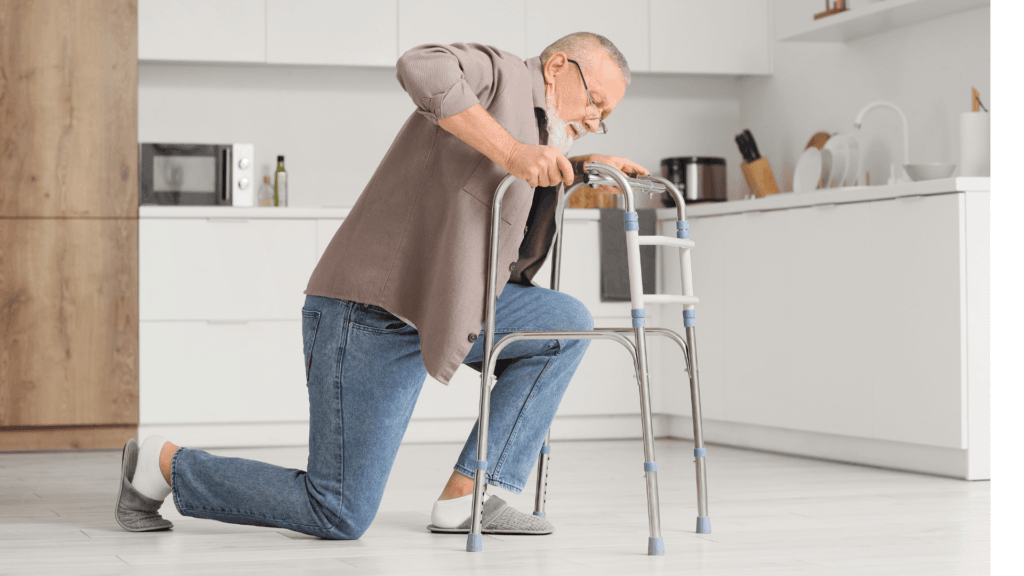
Let’s be clear about the stakes, without being alarmist about them. The Public Health Agency of Canada reports that falls are the leading cause of injury-related hospitalizations among Canadian seniors, and that between 20% and 30% of older adults fall each year. But here’s the part that matters more: falling is not a random event, and it is not an inevitable part of aging. Balance is a trainable skill, strength is buildable at every age, and the research on falls prevention for seniors through exercise is some of the strongest evidence in all of rehabilitation.
Research Stat: A Cochrane review of 108 randomized trials involving 23,407 older adults found that exercise reduces the rate of falls by 23% (rate ratio 0.77, 95% CI 0.71–0.83) — high-certainty evidence, the strongest grade Cochrane assigns.
Why Balance Changes as We Age — and Why It’s Trainable
Balance isn’t one thing. It’s a continuous conversation between three systems: your vision, your inner ear (the vestibular system), and the position sensors in your muscles and joints (proprioception). Your brain blends these inputs and answers with tiny, constant muscle corrections — hundreds per minute — that you never consciously notice.
With age, each part of that conversation can get a little quieter. Muscle mass and power decline (especially the fast, reactive power needed to catch a stumble), joint position sense dulls, vision changes, and the vestibular system loses sensitivity. Add medications that affect blood pressure or alertness, and the margin for error narrows.
Here’s the crucial point: every one of those trainable systems responds to practice. Strength responds to resistance work at any age — including in your 80s and 90s. Balance reactions sharpen with progressive challenge. Even the vestibular system recalibrates with targeted exercises, which is the entire basis of vestibular rehabilitation. Decline is real, but the slope is far more adjustable than most people believe.
The other thing worth naming is the confidence spiral. After a stumble — or sometimes just with growing caution — many older adults begin avoiding: fewer walks, no more stairs, shorter distances. Avoidance feels safe, but it quietly drains the very strength and balance that prevent falls, which increases risk, which increases fear. Breaking that spiral is one of the most valuable things a structured program does.
What the Evidence Actually Say About Falls Prevention for Seniors
Falls prevention for seniors is unusual in rehabilitation for just how strong the evidence is. The landmark Cochrane review is worth unpacking, because its details tell you what a good program should look like.
Exercise works — with high certainty. Across 59 trials and nearly 13,000 participants, exercise programs reduced the rate of falls by 23% compared with control. Exercise also reduced the number of people who fell at all by 15%. Cochrane graded both findings as high-certainty evidence — meaning further research is very unlikely to change the conclusion.
Source: Sherrington et al., Cochrane Database of Systematic Reviews, 2019. DOI: 10.1002/14651858.CD012424.pub2.
The type of exercise matters. The programs that worked best were built on balance and functional exercises — standing tasks that progressively challenge stability, practiced regularly. Balance and functional training alone reduced the rate of falls by 24%. Programs that combined balance work with resistance training were similarly effective. Walking programs alone, by contrast, were not enough — a genuinely useful finding, because “just walk more” is the most common advice older adults receive.
Source: Sherrington et al., Cochrane Database of Systematic Reviews, 2019. DOI: 10.1002/14651858.CD012424.pub2.
The challenge has to be real. For balance training to work, it has to be genuinely challenging — practiced at the edge of your stability, with safety measures in place, and progressed as you improve. Standing exercises that feel completely easy aren’t training balance; they’re rehearsing what you can already do. This is exactly where professional guidance earns its keep: finding the level that’s challenging enough to drive adaptation and safe enough to do confidently.
Research Stat: Balance and functional exercises alone reduced the rate of falls by 24% (rate ratio 0.76, 95% CI 0.70–0.81) — while walking programs alone did not show the same protective effect. What you practice matters more than how much you move.
Source: Sherrington et al., Cochrane Database of Systematic Reviews, 2019. DOI: 10.1002/14651858.CD012424.pub2.
When Dizziness Is Part of the Picture: The Vestibular Connection
For a meaningful number of older adults, unsteadiness isn’t just about strength — it’s about dizziness. Brief spinning when rolling over in bed or looking up to a high shelf often points to BPPV (benign paroxysmal positional vertigo), a mechanical inner-ear problem that is very treatable with specific repositioning techniques. More constant unsteadiness, motion sensitivity, or visual blurring with head turns can indicate reduced vestibular function — which responds to graded vestibular rehabilitation exercises.
This matters for falls because a dizzy nervous system is an unreliable balance partner. If dizziness is part of your story, a standard balance class isn’t enough; the vestibular component needs to be assessed and treated directly. Pursuit offers vestibular rehabilitation as a core service, and it integrates naturally with falls-prevention programming — often, treating the vestibular problem is the unlock that makes balance training effective.
Falls Prevention for Seniors at Pursuit Physiotherapy
We build falls-prevention care the same way we build every program — around the Pursuit Process:
Define Your Goal. Not “improve balance” in the abstract — your goal. Walking the Gorge waterfront without a companion. Getting back to the garden. Carrying groceries up your own stairs. The goal defines the program.
Measure What Matters. We test where you actually stand: validated balance measures, sit-to-stand strength, gait speed, single-leg stance, and — where dizziness is involved — vestibular screening. These numbers establish your baseline and, importantly, your progress.
Personalized Pain Relief. Many older adults limit activity because of pain — an arthritic knee, a cranky back — not just balance. Addressing pain drivers is often step one to making balance training possible.
Tailored Programming. Your program is built to your tested level: progressive standing balance challenges, functional strength work (sit-to-stands, step-ups, carries), reactive stepping practice, and a realistic home program. Challenging enough to work, safe enough to trust.
Retest Metrics. Every few weeks we re-measure. Watching your single-leg stance time double, or your sit-to-stand count climb, does something numbers on a page rarely do — it rebuilds confidence with proof.
Fitness For Life. The end goal isn’t completing a program. It’s a durable habit of strength and balance work — independent, in a class, or with periodic check-ins — that keeps the gains for good.
Pursuit Philosophy: We don’t hand out generic balance sheets. Every falls-prevention program at Pursuit starts with measurement and is progressed against your retested numbers — because the evidence is clear that balance training only works when it’s genuinely challenging, and “challenging” is different for every person.
Active Training vs. Passive Caution: Two Very Different Strategies
Faced with fall risk, there are two responses. The passive strategy is restriction: move less, avoid stairs, stay in. It feels protective, but the evidence points the other way — restriction accelerates the losses in strength and balance that create risk in the first place.
The active strategy is the one the research supports: deliberately, progressively training the systems that keep you upright. It requires more effort and a little courage. It’s also the strategy that keeps the Dallas Road walks, the garden, and the independence.
A related honest note: physiotherapy here is not about eliminating all risk — nobody can promise that. It’s about shifting the odds meaningfully in your favour while expanding, rather than shrinking, your life. That’s a trade worth making.
How Physio, Chiro and Massage Therapy Work Together
Stiffness and muscle pain are underrated barriers to balance training — it’s hard to practice step-ups on a back that’s seized or calves that ache. At Pursuit, our physiotherapists, chiropractor and registered massage therapists work from a shared plan: physiotherapy drives the assessment, strength, and balance progression, while massage therapy helps manage the muscular aches and stiffness that come with new training — keeping the program comfortable enough to stick with.
Most extended health plans cover both, and we direct-bill most major insurers. Our Hillside Ave clinic is fully wheelchair and scooter accessible, with free 60-minute parking directly outside and bus stops nearby at Hillside and Blanshard and Douglas St.
Realistic Expectations: What Progress Looks Like
Balance improvement is real but gradual. In the research, effective programs ran for months, not weeks — meaningful falls-risk reduction comes from consistent practice, typically two to three hours per week of balance-challenging exercise, sustained over time. Early wins usually show up first as confidence: steadier turns, easier stairs, less hesitation. Measured gains in strength and stance time typically follow within 6–12 weeks. The protective effect compounds the longer you keep practicing.
If you’ve already had a fall, know this: one fall is a signal, not a sentence. It’s the single best reason to get assessed, because the evidence for exercise-based prevention applies most strongly to exactly this situation.
Book a Balance Assessment at Pursuit
Whether you’ve noticed the first flicker of unsteadiness, you’re managing dizziness, or a recent fall has shaken your confidence — the right time for a balance assessment is now, while there’s the most to build on. It’s also a meaningful gift to arrange for a parent.
Pursuit Physiotherapy
📍 102B–740 Hillside Ave, Victoria, BC
🚗 Free 60-minute parking on site, and easily accessible by transit
📅 Book online: pursuitphysiotherapy.janeapp.com
📞 (250) 363-9707
✉️ info@pursuitphysiotherapy.ca
No referral needed — direct billing available to all major extended health insurers
References
- Sherrington C, Fairhall NJ, Wallbank GK, Tiedemann A, Michaleff ZA, Howard K, Clemson L, Hopewell S, Lamb SE. Exercise for preventing falls in older people living in the community. Cochrane Database of Systematic Reviews. 2019, Issue 1. Art. No.: CD012424. DOI: 10.1002/14651858.CD012424.pub2.
- Public Health Agency of Canada. Surveillance Report on Falls Among Older Adults in Canada. Government of Canada.