If you’ve heard the words “dry needling” or “IMS” at a physiotherapy clinic in Victoria and aren’t sure what to make of them — this is the guide you’ve been looking for.
The Needle Question Everyone Asks
You came in for your sore neck — or your stubborn hip flexor, or that shoulder that’s been tight since last spring’s Galloping Goose training block — and your physiotherapist mentioned dry needling. Maybe you nodded and booked it. Maybe you quietly Googled it on the bus home.
Either way, you have questions. Does it hurt? Is it acupuncture? Is there actual science behind it? And why would a physio clinic in Victoria use needles when there are plenty of other tools available?
These are the right questions to ask. Here’s what the evidence actually says.
What Is Dry Needling, and How Is It Different From Acupuncture?
Dry needling and acupuncture both use thin filiform needles — but the similarity mostly ends there.
Acupuncture is rooted in traditional Chinese medicine and works with a system of meridians and qi (energy flow) to promote balance and wellbeing throughout the body. It has its own deep theory and clinical framework.
Dry needling, by contrast, is grounded in Western neurophysiology and musculoskeletal anatomy. The needle is inserted directly into a myofascial trigger point — a hyperirritable, taut band of muscle tissue that is generating pain, restricting movement, and refusing to release through conventional stretching or massage alone.
In British Columbia, physiotherapists who use dry needling must complete extensive post-graduate training and be registered as IMS practitioners with the College of Physical Therapists of BC. IMS (Intramuscular Stimulation) is a specific dry needling system developed by Dr. Chan Gunn, a Vancouver physician, and is widely used in BC physio clinics — including Pursuit Physiotherapy on Hillside Ave in Victoria.
The key distinction: dry needling and IMS target the neuromuscular system directly. There is no substance injected (hence “dry”) — the therapeutic effect comes entirely from the mechanical response of the needle.
What Actually Happens When the Needle Goes In?
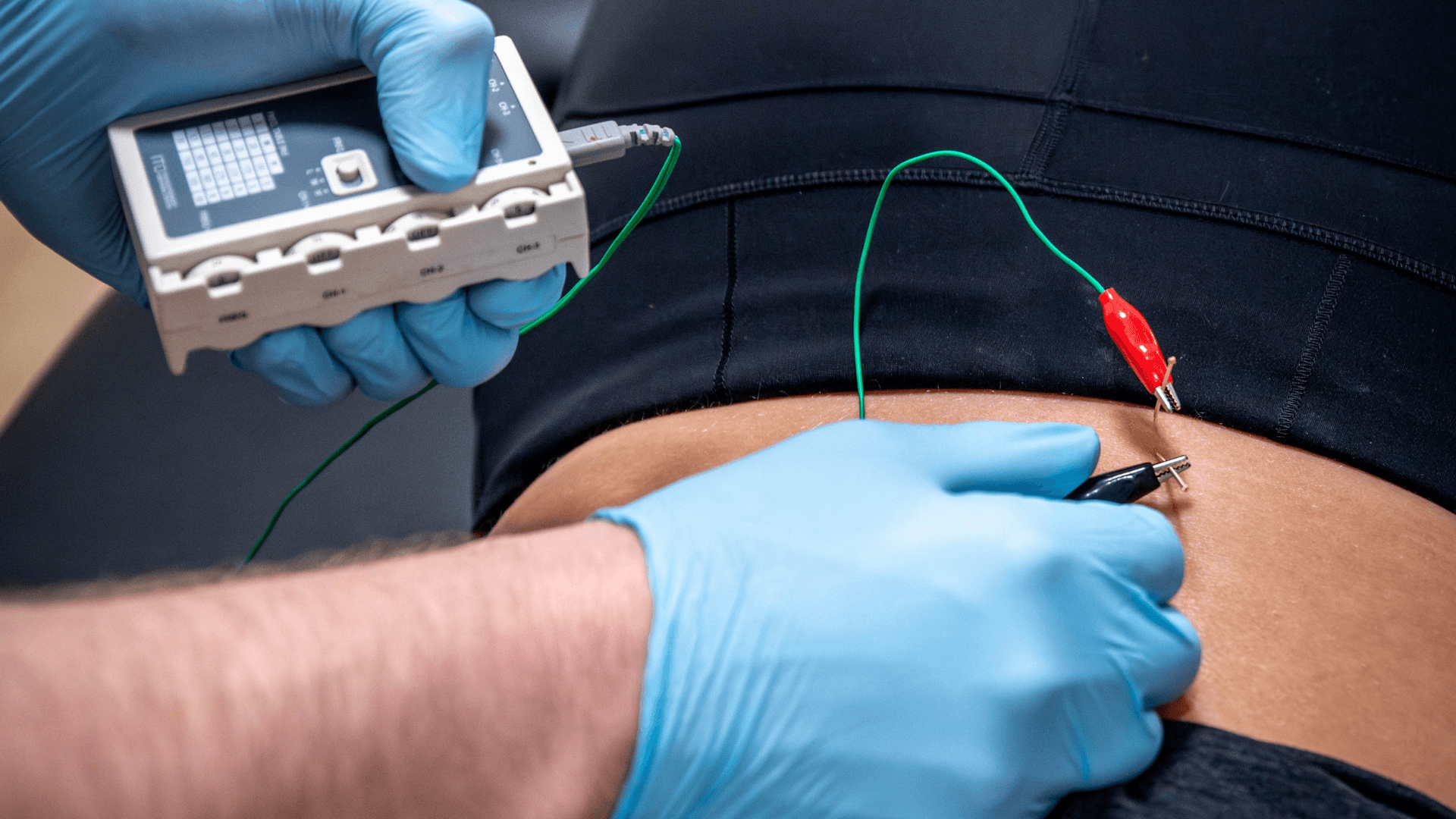
When a fine needle is inserted into a trigger point, it produces what’s called a local twitch response — a brief, involuntary contraction of the muscle fibres. This twitch is actually a good sign. It indicates the needle has found the dysfunctional tissue.
Following the twitch, several physiological things happen:
– The muscle fibres release and lengthen
– Local circulation to the area improves
– The neurochemical environment around the trigger point shifts — inflammatory mediators decrease
– The nervous system’s sensitisation in that area begins to reset
This is why dry needling can reach tissue that manual therapy struggles to access. Trigger points in deep rotator cuff muscles, the piriformis, or the deep cervical extensors are anatomically difficult to compress or mobilise by hand. A needle goes directly to the source.
RESEARCH STAT: A 2024 systematic review and meta-analysis in the Journal of Bodywork and Movement Therapy found that deep dry needling combined with stretching produced significantly greater reductions in pain and improvements in pressure pain threshold compared to stretching alone in patients with myofascial trigger points. PubMed ID: 39593416.
What Conditions Does Dry Needling Help?
Dry needling is best suited to conditions where myofascial trigger points are a primary driver of pain or restricted movement. This includes — but is not limited to:
Neck and cervical pain — especially chronic tension, postural dysfunction from desk work, and cervicogenic headaches (headaches originating from the neck)
Lower back pain — particularly when the erector spinae, multifidus, quadratus lumborum, or gluteal muscles are involved
Shoulder pain and rotator cuff issues — the infraspinatus, supraspinatus, and subscapularis are common trigger point sites that respond well
IT band syndrome and runner’s knee — tension in the TFL and lateral hip muscles that isn’t releasing with stretching alone
Plantar fasciitis and heel pain — the triceps surae (calf) complex frequently harbours trigger points that refer pain into the plantar fascia
Hip and gluteal pain — the piriformis, glute medius, and hip flexors accumulate trigger points especially in sedentary workers and athletes
Tennis elbow and golfer’s elbow — forearm extensor and flexor trigger points are often the missing piece in chronic elbow pain that hasn’t resolved with standard physio
RESEARCH STAT: A 2025 systematic review and meta-analysis examining dry needling combined with exercise versus exercise alone across 255 patients found that the combined approach reduced pain significantly more than exercise alone in lateral epicondylitis, patellar tendinopathy, and rotator cuff tendinopathy. (PMC12538665.)
It’s worth being clear: dry needling is not a standalone treatment and it’s not right for every patient or every condition. It’s a tool — a powerful one — that works best within an active, progressive rehabilitation program. At Pursuit, a session of dry needling is always embedded in a broader treatment plan, never offered as a one-off passive fix.
Does Dry Needling Hurt?
Honestly — it’s a reasonable question, and you deserve an honest answer.
The needle itself is very fine — comparable to an acupuncture needle — and the insertion is generally not painful. What you will likely feel is the local twitch response: a brief, deep muscle cramp or ache that lasts a second or two. Some people describe it as a strong muscle contraction or a “good hurt.” Most find it very tolerable once they know what to expect.
After the session, you may feel some localised soreness in the treated area for 24–48 hours — similar to what you feel after a hard workout or deep massage. This is normal and expected, and it typically resolves quickly. Most people feel measurable improvement in range of motion and pain levels within 1–3 sessions.
The most important thing: your physiotherapist will talk you through exactly what to expect before any needles are used, and you can stop at any time. This is your recovery, and informed consent is non-negotiable at Pursuit.
Active vs. Passive Therapy: Where Does Needling Fit?
There’s a persistent misconception in physiotherapy that all needle-based treatment is “passive” — that you’re just lying there while something is done to you.
At Pursuit, that’s not how it works.
Passive therapy — in the sense of treatment where the patient plays no active role — is not our model. Pursuit does not use ultrasound, IFC, TENS, laser therapy, or any other passive electrotherapy modality. This is a deliberate, evidence-based decision. The research consistently shows that active rehabilitation produces superior long-term outcomes for musculoskeletal conditions compared to passive modality-reliant approaches.
Dry needling occupies a specific, well-defined role: it’s a tool for resetting dysfunctional tissue so that active rehabilitation can proceed more effectively. Think of it as clearing the roadblock before building the road. A shoulder muscle locked in a trigger point pattern cannot be loaded progressively no matter how diligently you do your exercises. Dry needling releases that lock — then the real work begins.
PURSUIT PHILOSOPHY: “Quality Care Over Quick Fixes.” Dry needling at Pursuit is never a standalone session. It’s integrated into your treatment plan to accelerate the gains from your active program — not replace it.
The treatment session after dry needling is where the window of neuroplasticity gets used. Your physiotherapist will move you through specific exercises, mobility work, or manual techniques that reinforce the improved tissue state. That’s the combination that produces lasting change.
How Physiotherapy and RMT Work Together With Dry Needling
At Pursuit, dry needling is used by our physiotherapists. But it often works synergistically with what our Registered Massage Therapists (RMTs) do — and understanding this coordination is important.
Your physiotherapist identifies the primary driver of your condition: which muscles are generating the pain, which movement patterns are compromised, and where trigger points are located in the load-bearing chain. Dry needling addresses the deep neuromuscular dysfunction at the trigger point level — resetting the tissue to its resting length and restoring normal motor unit recruitment.
Your RMT then works at the broader tissue level: reducing protective tone in the surrounding musculature, improving fascial mobility, enhancing local circulation, and creating the neurological conditions that support motor learning. The RMT doesn’t replace the physio, and the physio doesn’t replace the RMT — they’re working from a shared understanding of what your body needs and in what sequence.
THE INTEGRATION PRINCIPLE: Physiotherapy identifies the source, dry needling resets the tissue, and RMT prepares the broader system. Together, they create a treatment environment that active rehabilitation can build on — not just temporarily relieve.
A 2022 systematic review of multimodal approaches for musculoskeletal pain consistently found that combined interventions — including needling alongside manual therapy and exercise — produced greater improvements in pain and function than any single modality alone.
Note: RMT coverage under ICBC depends on your specific claim and adjuster approval. Check with ICBC what your claim covers.
What to Expect at Your First Dry Needling Appointment at Pursuit
Here’s what a typical dry needling session looks like at Pursuit:
Assessment first
Your physiotherapist reviews your current symptoms, movement patterns, and any changes since the last session. Trigger points are identified through palpation — not guesswork.
Informed consent
Your physiotherapist explains exactly what will happen, what you might feel, and answers any questions. If you’re new to needling, this conversation matters.
Treatment
Needles are placed in the identified trigger points. The treatment typically lasts 10–20 minutes. You may feel the local twitch response.
Post-needling exercise
This is not optional — it’s the point. You’ll move through specific exercises or mobility work while the tissue is in its improved state.
Home program
You’ll leave with clear guidance on what to do (and not do) in the 24–48 hours following. This might include gentle movement, heat, hydration, and specific exercises.
Sessions are one-on-one
You’re not sharing your physiotherapist with another patient in the next room. Your entire session is focused on you.
The Pursuit Approach to Dry Needling
At Pursuit, dry needling is one tool in a comprehensive, objective-driven approach to rehabilitation. Every patient who receives dry needling at our clinic starts with the same foundation:
Define Your Goal — what does recovery look like for you? Return to trail running on the Galloping Goose? Getting through a workday without neck pain? Lifting overhead without restriction?
Measure What Matters — before we needle anything, we establish baseline measurements: range of motion, pressure pain threshold, strength metrics, and functional performance. These numbers get retested throughout your care.
Personalized Pain Relief — dry needling, when appropriate, is selected because it addresses the specific neuromuscular dysfunction driving your pain. Not because it’s quick. Not because it’s popular. Because the assessment indicates it’s the right tool.
Tailored Programming — your exercise program is built around what your body can actually do post-treatment. Progressive loading begins immediately.
Retest Metrics — we measure again. If the needle isn’t producing objective improvements, we reassess. Nothing is continued on faith alone.
Fitness For Life — the goal isn’t a pain-free appointment. The goal is a pain-free life. Dry needling is a bridge — not a destination.
Realistic Expectations
Dry needling is not a magic fix. Here’s what the evidence supports — and what it doesn’t.
Most patients see meaningful improvement in pain and range of motion within 2–4 sessions when dry needling is combined with an active rehabilitation program. Conditions with longstanding chronicity (12+ months) may take longer. Results are cumulative — each session builds on the last.
What we won’t do at Pursuit is promise you a specific number of sessions or a guaranteed outcome. Recovery is not linear, and every nervous system responds differently. What we will guarantee: a thorough assessment, honest communication about what we’re finding and why, and a plan that adapts as you progress.
Your recovery isn’t predetermined. The research — and our clinical experience — is clear that with the right combination of interventions and active participation, outcomes are significantly better than many patients expect.
Book Dry Needling at Pursuit Physiotherapy in Victoria
If you’re wondering whether dry needling or IMS is the right next step for your recovery — come in and find out. A thorough assessment is the starting point. We don’t apply tools without understanding your full picture first.
Pursuit Physiotherapy
102B–740 Hillside Ave, Victoria, BC
Free 60-minute parking directly outside. Transit accessible (Hillside Ave at Blanshard and Douglas St. bus stops).
Direct billing available for ICBC and all major extended health insurers. No physician referral required.
References
- Gattie, E., Cleland, J.A., & Snodgrass, S. (2017). The Effectiveness of Trigger Point Dry Needling for Musculoskeletal Conditions by Physical Therapists: A Systematic Review and Meta-analysis. Journal of Orthopaedic & Sports Physical Therapy, 47(3), 133–149. DOI: 10.2519/jospt.2017.7096
- Llamas-Ramos, R., et al. (2024). Effectiveness of deep dry needling combined with stretching for the treatment of pain in patients with myofascial trigger points: A systematic review and meta-analysis. Journal of Bodywork and Movement Therapies. PubMed ID: 39593416
- Cotchett, M., et al. (2025). Effectiveness of Dry Needling Combined With Exercise Versus Exercise Alone in Various Tendinopathies: A Systematic Review and Meta-Analysis. PMC ID: PMC12538665
- Rodriguez-Huguet, M., et al. (2022). Effectiveness of Dry Needling of Myofascial Trigger Points in the Triceps Surae Muscles: Systematic Review. Healthcare, 10(10), 1862. PMC: 9602116
- Kietrys, D.M., et al. (2013). Effectiveness of Dry Needling for Upper-Quarter Myofascial Pain: A Systematic Review and Meta-analysis. Journal of Orthopaedic & Sports Physical Therapy, 43(9), 620–634. DOI: 10.2519/jospt.2013.4668