Debunking the myth that strength training leads to “bulking” for women
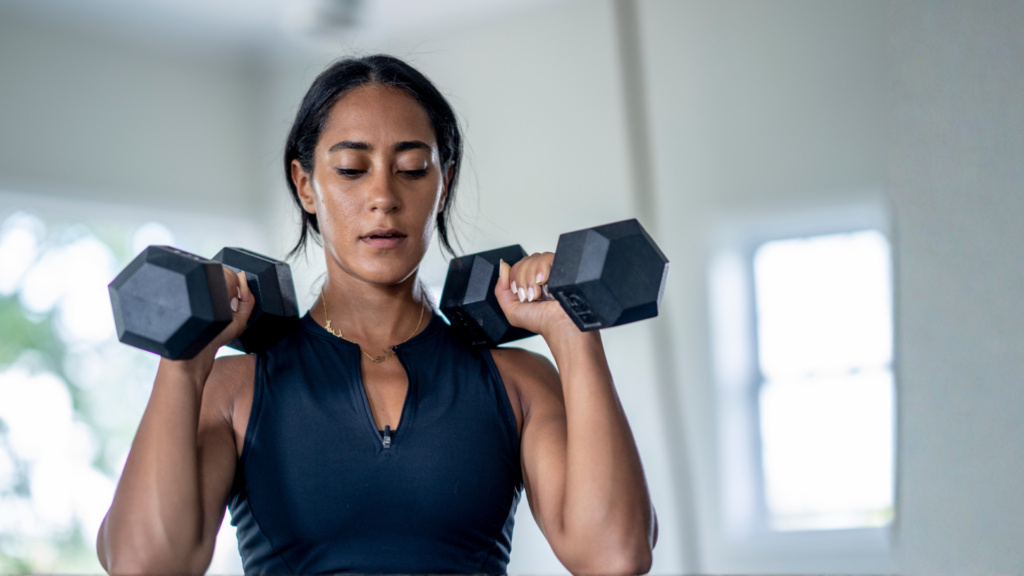
Have you ever questioned whether to strength train as a woman, or had women around you hesitate to strength train due to the fear of “bulking”?
You’re not alone! It is a common misconception that if you strength train as a woman, you will “bulk up”.
Let’s be clear, building muscle and “bulking up” is an amazing goal to have! However, for some women it is a deterrent due to social stigma.
We tend to hear this a lot from women who grew up in the cardio craze of the 1980’s. Systematic reviews have also revealed this in the literature, with women expressing that a barrier for strength training is not wanting to “build bulky muscles”.[1]
Current research has shown that this is not the case, and that strength training is vital for health and healthy aging!
So, let’s debunk this myth shall we!
Why Women Don’t “Bulk” from Strength Training (Unless They Intentionally Train for It)
“Bulking” requires a very high intensity and frequency of workouts, & genetics
The building of muscle (aka, hypertrophy) can be increased when doing higher volume loads with frequent performance.[2] In order to maximize hypertrophy, the protocol typically consists of 3 sets of 8-12 reps, 3x per week.[2] This training needs to be sustained for 8-12 weeks minimum to observe noticeable hypertrophic changes.[2,3] The muscle gained by this will also depend on genetic factors such as hormones, muscle fiber type and quantity, meaning there are genetic limitations to “bulking”.
Need a surplus of calories
In order to significantly grow muscle mass, research suggests eating in a caloric surplus.[4] This means eating more calories than you are burning throughout the day. For hypertrophy you also need a surplus of protein. Your body needs additional energy in order to repair and build large amounts of muscle.
Women have lower testosterone levels
Testosterone is a hormone that aids in the building of muscle. It does this by binding to androgen receptors within the muscle cells, which promotes protein synthesis and muscle hypertrophy.[5] Women have significantly less testosterone than men, which doesn’t mean that women can’t build muscle; they are just starting at a lower baseline and it may be a slower process.
Strength training can help to boost muscle definition
Strength training increases lean muscle which burns more calories at rest, leading to an increased metabolism. This slow gradual process can aid in the reduction of body fat and increase muscle definition, which people often refer to as “toned” rather than “bulky”.
Benefits that we DO see from strength training in women
At Pursuit Physiotherapy, our goal is to build your capacity so you can enjoy pain-free living, whether you are training for the TC10K or simply wanting to get down on the floor to play with your kids. We don’t avoid movements; we aim to help you manage them.
Here is the broad roadmap we use to help patients reclaim the squat:
Increased strength
- Increased muscle & functional strength [1] which can make daily tasks easier (lifting groceries, carrying kids, climbing stairs, manual work etc).
Faster metabolism
- Muscle tissue burns more calories at rest, so strength training boosts resting metabolic rate.
Stronger joints
- Better joint stability & reduced injury risk.
- Strengthening the muscle around joints which can help reduce knee, hip and back pain.
- Improved balance and coordination.
Stronger bones
- Women are at a higher risk for osteoporosis especially after menopause.[6][7]
- Strength training builds bone density & reduces fracture risk.[1][8]
Healthy Aging
- Maintains muscle, which steadily atrophies with age at a rate of ~1% beginning around middle-age.[1,9]
- Protects mobility and independence.
Mental Health Benefits
- Positive impacts on mental health including increased personal autonomy, supportive social interactions [10], emotional resilience, confidence and reduced stress.[11]
Start Building Strength
These benefits are just to name a few! The World Health Organization recommends adults do at least 2 days a week of muscle-strengthening activities that involve major muscle groups in order to maintain good physical health.[12] The moral of the story is that women should absolutely incorporate strength training into their fitness routine, and not worry about the myth of “bulking”!
Key References
- Vasudevan A, Ford E. Motivational Factors and Barriers Towards Initiating and Maintaining Strength Training in Women: a Systematic Review and Meta-synthesis. Prev Sci. 2022;23:674–695. https://doi.org/10.1007/s11121-021-01328-2
- Schoenfeld BJ, Grgic J, Van Every DW, Plotkin DL. Loading Recommendations for Muscle Strength, Hypertrophy, and Local Endurance: A Re-Examination of the Repetition Continuum. Sports (Basel). 2021;9(2):32. doi: 10.3390/sports9020032
- Schoenfeld BJ, Contreras B, Kreiger J, Grgic J, Delcastillo K, Belliard R, Alto A. Resistance Training Volume Enhances Muscle Hypertrophy but Not Strength in Trained Men. Medicine Science in Sports & Exercise. 2018;51(1):94–103. doi: 10.1249/MSS.0000000000001764
- Aragon AA, Schoenfeld BJ. Magnitude and Composition of the Energy Surplus for Maximizing Muscle Hypertrophy: Implications for Bodybuilding and Physique Athletes. Strength and Conditioning Journal, 2020;42(5):p 79-86. DOI: 10.1519/SSC.0000000000000539
- Rojas-Zambrano JG, Rojas-Zambrano AR, Rojas-Zambrano AF, Barahona-Cueva GE. Benefits of Testosterone Hormone in the Human Body: A Systemic Review. Cureus, 2025;17(2):e78785. doi: 10.7759/cureus.78785.
- Zhang W, Li X, He Q, Wang X. Effects of exercise on bone metabolism in postmenopausal women: a systematic review and meta-analysis of randomized controlled trials. Front. Endocrinol. 2025;16. https://doi.org/10.3389/fendo.2025.1597046
- Ji MX, Yu Q. Primary osteoporosis in postmenopausal women. Chronic Diseases and Translational Medicine. 2015;1(1):9-13. https://doi.org/10.1016/j.cdtm.2015.02.006
- Kelley GA, Kelley KS, Tran ZV. Resistance training and bone mineral density in women: a meta-analysis of controlled trials. Am J Phys Med Rehabil. 2001;80(1):65-77. doi: 10.1097/00002060-200101000-00017.
- Wilkinson DJ, Piasecki M, Atherton PJ. The Age-Related Loss of Skeletal Muscle Mass and Function: Measurement and Physiology of Muscle Fibre Atrophy and Muscle Fibre Loss in Humans. Ageing Research Reviews. 2018;47:123–32. doi:10.1016/j.arr.2018.07.005
- Hall FC, Noonan RJ. A qualitative study of how and why gym-based resistance training may benefit women’s mental health and wellbeing. Performance Enhancement & Health. 2023;11(3):100254. https://doi.org/10.1016/j.peh.2023.100254
- Marrella G. Exploring women’s psychological and emotional experiences in long-term strength training adherence. American Journal of Health Education. 2024;55(1):33-47. https://doi.org/10.1080/19325037.2023.2277934
- World Health Organization. Physical activity. World Health Organization; 2026. https://www.who.int/initiatives/behealthy/physical-activity
Disclaimer: The content provided here is for educational purposes only and does not constitute medical advice. Every injury is unique. For a specific diagnosis and treatment plan, please book an appointment with our team.